The Living Paul: An Introduction to the Apostle's Life and Thought by Anthony C. Thiselton
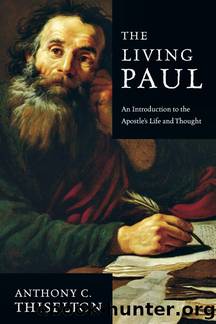
Author:Anthony C. Thiselton [Thiselton, Anthony C.]
Language: eng
Format: mobi
Publisher: InterVarsity Press
Published: 2011-09-13T00:00:00+00:00
Bultmann asserts, following Paul, that as ârightwisedâ people, Christians âhave peace with Godâ (Rom. 5.1, 5.9).14 This ârighteousnessâ, he says, means the abolition of objective enmity or hostility. In faith the believer turns away from himself or herself to God. Nygren also quotes Paul: ânot having a righteousness of my own, based on law, but that which is through faith in Christ, the righteousness of Godâ (Phil. 3.9), and declares that ârighteousness is an objective relationshipâ.15 It is âbeing right with Godâ resulting from his verdict, and living out subsequently being âin Christâ. Tom Wright and others see this act of putting things right as an implicate of Godâs covenant faithfulness as formerly portrayed in the Psalms, Isaiah, Daniel 9, and elsewhere in the Old Testament.16 Strictly speaking, it is also an anticipation in the present of Godâs verdict which belongs to the judgement day. It is part of what Barrett calls âsetting things and persons rightâ.17 Strictly, judgement and justification belong together at the last day (Rom. 2.12â13; Gal. 5.5). Richardson, too, sees this as a pronouncement of the last judgement, brought forward by faith.18
This brings us to a major question. How prominent in Paul is justification by grace through faith alone? Martin Luther and John Calvin saw it as a central theme. On Gal. 2.16â17 Luther calls justification the rule of Christianity, whereby sin is forgiven, and our sin is âlaid upon Christâ (Isa. 53.5).19 Human righteousness, like human wisdom, is âtorn downâ by Paulâs gospel. The Pietist or âLeft-Wingâ Reformers begin, like him, with faith alone, but by imposing legalistic codes of holiness on Christians, they unwittingly become âteachers of the lawâ, like some of the Galatians.20 Calvin urged the importance of the theme because âunless you understand first of all what your position is before God, and what the judgment which he passes upon you, you have no foundation on which your salvation can be laidâ.21
Criticism of Lutherâs and Calvinâs view comes most recently from Stendahl and Sanders, but earlier from Weiss and from Albert Schweitzer. Schweitzer argued, âBy taking the doctrine of righteousness by faith as the starting-point the understanding of the Pauline world of thought was made impossible.â22 Justification, he argues, was a mere tributary to Paulâs theology. Ernst Käsemann rightly insists that Stendahlâs criticisms are far from new;23 and F. C. Baur saw Romans 9â11 as the key climax of the epistle.
The burden of Schweitzerâs attack on tradition was first that justification or âbeing counted right with Godâ constituted an affair for the individual, whereas Paul addresses a communal problem. Second, he saw no logical connection between justification with the gift of the Holy Spirit and ethics. Further, this theme is largely restricted to addressing Judaizing Christians; and it isolates the atoning death of Christ from dying and being raised with Christ. Wright, however, comments on the approach shared by Wrede and Schweitzer: âWrede, aware of the same phenomena which âthe new perspectiveâ [explained below] has highlighted, but without any glimmer of the
Download
This site does not store any files on its server. We only index and link to content provided by other sites. Please contact the content providers to delete copyright contents if any and email us, we'll remove relevant links or contents immediately.
Fangirl by Rainbow Rowell(9229)
How to Bang a Billionaire by Alexis Hall(8145)
Wonder by R. J. Palacio(8097)
The Thirst by Nesbo Jo(6932)
The Space Between by Michelle L. Teichman(6929)
Assassin’s Fate by Robin Hobb(6199)
Wiseguy by Nicholas Pileggi(5770)
The Night Circus by Erin Morgenstern(5217)
Paper Towns by Green John(5178)
The Kite Runner by Khaled Hosseini(5170)
Bittersweet (True North #1) by Sarina Bowen(4843)
Gerald's Game by Stephen King(4641)
Too Much and Not the Mood by Durga Chew-Bose(4337)
Pillow Thoughts by Courtney Peppernell(4271)
Goodbye Paradise(3799)
Twelve Days of Christmas by Debbie Macomber(3559)
Good by S. Walden(3548)
The Rosie Effect by Graeme Simsion(3460)
The Cellar by Natasha Preston(3334)
